
When the Insurance Renewal Goes Up, Someone Absorbs the Cost. It Is Usually the Employee — But It Does Not Have to Be.
Group Benefits Better, avoid bigger annual increases, unhappy employees, and other fixes!
July 7, 2026
Most employers do not give every employee a pay raise equal to the increase in their health insurance premium. That gap does not disappear — it comes out of someone's standard of living.
David Vudragovich · AgentDavidCares.com · Licensed Independent Group Benefits Advisor
There are people who look into a crystal ball and tell you what you want to hear about the future.
That is not this.
This is a look at what the data actually shows — past and present — so that business owners and HR professionals can make decisions with clear eyes before the next renewal letter arrives.
The financial reality most employees are already carrying
Before a single insurance premium increases, a significant portion of the American workforce is already stretched thin.
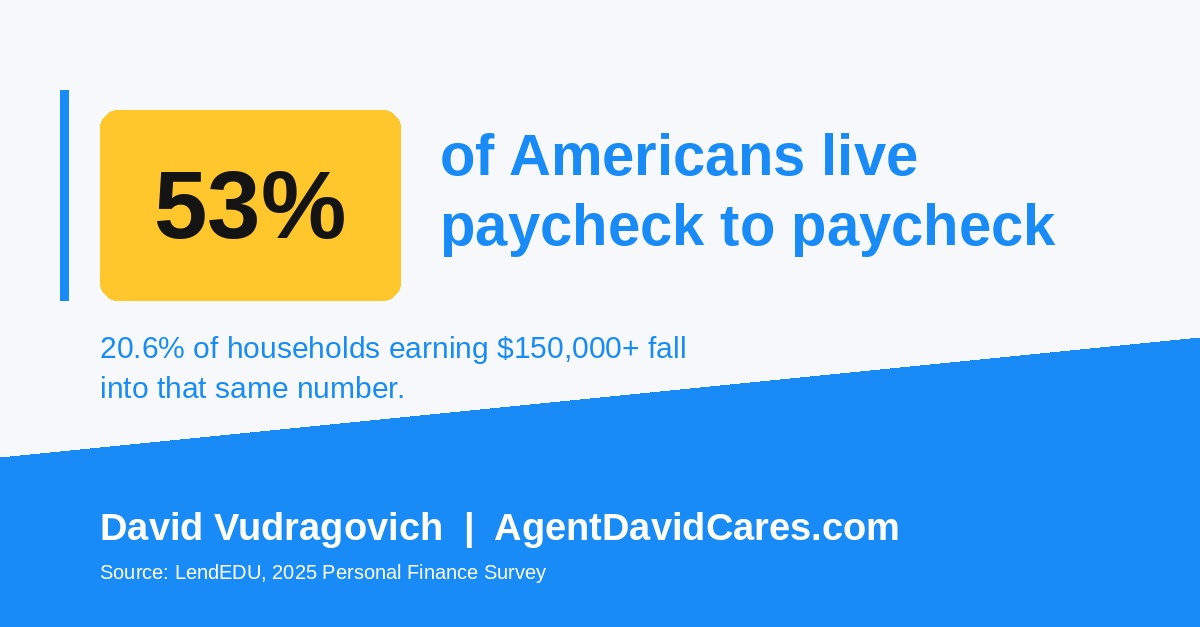
53% of Americans say they are living paycheck to paycheck — LendEDU 2025 Personal Finance Survey
40% could not cover a $1,000 emergency expense in cash — LendEDU 2025
20.6% of households earning $150,000 or more still report living paycheck to paycheck
This is not exclusively a low-income problem.
It spans income levels, age groups, and industries.
It means that for a meaningful portion of any workforce, there is very little margin between what comes in and what goes out.
Now add a health insurance premium increase on top of that.
What happens when the premium goes up and the paycheck does not
When a group health insurance renewal comes in higher — whether 8%, 12%, or 18% — the employer has a decision to make about how much of that increase to absorb and how much to pass along to employees through higher payroll deductions.
When your health insurance renewal comes in higher and you pass that cost to employees — are you also giving them a raise equal to that increase? Most employers are not. That gap comes directly out of their standard of living.
That does not make employers unreasonable or uncaring.
It makes them human beings running businesses under real budget constraints.
But it does mean the cost lands somewhere — and that somewhere is almost always the employee's household budget.
What that looks like in a real life
Every employee is different, and every situation is unique.
But consider what a modest increase in monthly premium deductions actually means for someone already operating with little margin.
It is not always dramatic.
Sometimes it is the weekly dinner out that gets cancelled.
Sometimes it is the daily coffee that quietly disappears from the morning routine.
For employees who have already made those cuts, the next decision is harder.
It might mean buying less nutritious groceries.
It might mean pulling back on a child's extracurricular activity.
It might mean choosing between the copay for a doctor visit and keeping the lights on — and choosing to skip the doctor.
None of these are dramatic headlines.
They are quiet, private decisions that happen at kitchen tables — and they are happening in the households of employees at businesses of every size and industry.
When the math of staying changes, employees start looking
When an employee's standard of living erodes enough, the math of staying changes.
Some will look for an employer offering similar pay but a lower employee premium contribution — giving them more take-home pay even if the coverage itself is comparable or slightly less robust.
Others, particularly those who are younger and healthier, may calculate that going without group coverage and accessing individual plans through the Affordable Care Act marketplace — with subsidy assistance — leaves them financially better off than staying on a plan they can no longer comfortably afford.
Neither of these decisions reflects a lack of loyalty.
They reflect basic financial survival.
Gallup research found that engaged employees require a 31% pay increase before they will seriously consider leaving a job they value.
But a reduction in effective take-home pay — which is exactly what a premium increase without a corresponding raise represents — moves that needle in the wrong direction quietly, over time, without showing up on any HR report until someone puts in their notice.
A different approach to the renewal conversation
Most agents — or employers going directly to a single carrier — bring one product to the renewal conversation: a group health insurance plan.
The premium either goes up or it does not, and the employer signs or shops around for a slightly different version of the same thing.
There is another way.
By combining a wellness plan, a gap plan, and a group health plan — and by working with multiple carriers rather than being limited to one — it is possible to structure coverage that reduces what employees pay out of pocket, slows annual renewal increases, and in many cases results in employees taking home more money than before.
That is not a sales pitch.
It is what happens when you break the historic model and use newer available products and options.
The renewal letter is coming regardless.
The question is whether the plan in place is working as hard as it can for the people it is supposed to protect.
Before you renew — a word of advice
HR professionals and business owners are best served by working with an independent agent rather than going directly to a single carrier. A carrier can only offer what they sell. An independent agent works with multiple carriers and multiple product lines, meaning the recommendation is built around what fits the group — not what fits the carrier's portfolio. Beyond better options, an independent agent saves the business owner and HR department significant time — giving HR back the hours they need to focus on people, not paperwork.
Frequently Asked Questions
Q: Why does my group health insurance renewal keep going up every year?
A: Traditional fully insured plans price premiums based on the entire insurance pool — not your specific group's health. Healthy groups end up subsidizing higher-risk groups. A level funded plan prices your group based on your actual claims history, which can significantly slow annual increases.
Q: What happens when employers pass premium increases to employees?
A: When employee payroll deductions increase without a corresponding raise, effective take-home pay decreases. Gallup research found that engaged employees require a 31% pay increase before considering leaving — but a reduction in take-home pay moves that needle in the wrong direction quietly, without showing up on any HR report until someone puts in their notice.
Q: Is there an alternative to just signing my renewal every year?
A: Yes. An independent group benefits advisor works with multiple carriers and multiple products — not just one carrier's plan. Combining a wellness plan, Medical Balance Protection™, and group health coverage can reduce what employers spend while improving what employees receive.
Q: How do I find an independent group benefits advisor?
A: Start at AgentDavidCares.com/RP for a free benefits review. An independent advisor is paid by the carrier — no additional cost to the employer.
This article was developed with AI assistance and reflects the experience, voice, and opinions of David Vudragovich