
Most companies do not lose good employees over one bad day. They lose them slowly, over months of small signals nobody addressed. Matt Luensmann, a fractional recruiting leader who works with growing companies from line roles through the C-suite, sees this pattern constantly. So does David Vudragovich, a licensed independent group benefits advisor. Different lanes, same warning sign.
If you are reading this because something feels off, you are probably not imagining it.
What an empty seat actually costs
Replacing an employee typically runs 50 to 200 percent of that person's annual salary. Most conversations about turnover stop at that number. Luensmann brings attention to what usually gets left out. An experienced customer service representative who leaves does not just cost a paycheck. Their replacement, however capable, starts from zero with the customers that rep already knew by name.
The cost does not stop with the person who left. Remaining team members are roughly 9.1 percent more likely to quit within months of a colleague's departure, with that risk peaking around day 70 and lingering to nearly day 135. On smaller teams, six to ten people, the odds climb to nearly 15 percent. One empty seat can quietly put a second one at risk.
Culture is bigger than it looks
Culture gets treated as a vibe, something HR handles once a year in a survey. Luensmann treats it as a system, built from training, transparency, and how a company handles internal promotion, not just how the break room feels.
One of the clearest signals is what happens when a company hires from outside instead of promoting from within. External hires typically take around 8 months to reach full productivity, compared to about 4 months for an internal promotion, and they leave at a noticeably higher rate in their first year. Passing over a qualified internal candidate does not just cost ramp-up time. It tells the rest of the team what actually gets rewarded.
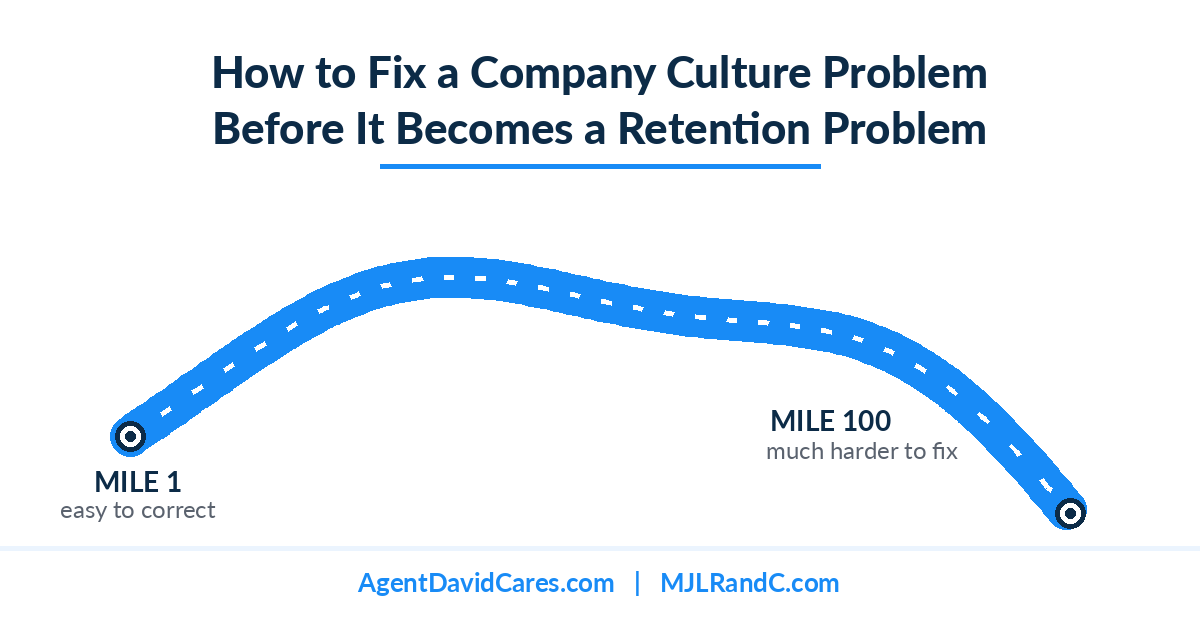
"Better to solve the culture problem earlier than later," Luensmann says. He compares it to course correcting on a drive. Easy to adjust after one wrong mile. Much harder after a hundred.
The part that rarely gets mentioned
Vudragovich sees a version of this from the benefits side. An employee who comes back to work after a major medical event is not just healed or not healed. If they are still worried about a bill insurance did not fully cover, that worry follows them to their desk. Financial peace of mind is not separate from culture. It is one of the quieter parts of it.
"Employees taking more money home is generally good for morale," Vudragovich says. Take-home pay is one form of peace of mind. Knowing they are protected if a major medical event happens is another, and that second piece is where most companies stop short.
A good independent agent does not stop at selling a policy. The job is structuring benefits so employees are actually protected from a real emergency, then making sure they understand what they have, instead of leaving a guide to sit in a drawer nobody opens.
That is the difference between an employer offering health insurance and an employer offering more than health insurance. The coverage itself becomes part of the culture, proof the company has a plan for taking care of its people if something goes wrong, not just a line on a benefits statement. Culture and coverage end up closer together than most companies assume.
The fix does not need to be complicated
Both problems share the same shape, diagnose honestly, then act on what is found. For Luensmann, that means running an employee survey if it has been a while, but only if someone is going to act on what it says. A survey that gets filed away does more harm than no survey at all, since employees notice when nothing changes. For Vudragovich, it means structuring the benefits correctly, then making sure people actually understand them. Same shape, run it, then act on it.
"Do not be afraid of finding out what it is," Luensmann says. "Once you know where you stand, you can correct your direction if needed."
Where to start
If what you are reading sounds like your team right now, the exits that felt sudden but were not, the internal candidate you passed over, the sense that something is off but you cannot point to it, the earlier you name it, the cheaper it is to fix.
- If the problem is who is on your team and how they got there, hiring, promotion decisions, or a retention pattern you cannot quite explain, that is Luensmann's lane. matt@mjlrandc.com Phone number 425-245-5318
- If your employees are unsure whether their health insurance benefits actually hold up, or provide real value, that is Vudragovich's lane at AgentDavidCares.com.
You do not have to have it fully diagnosed before you reach out. That is the first conversation, not a prerequisite for having one.
This article is for educational purposes only and is not intended to create alarm.
AgentDavidCares.com does not provide tax, legal, or compliance advice. Please consult your attorney, accountant, or benefits compliance specialist.
This article was developed with AI assistance and reflects the experience, voice, and opinions of David Vudragovich.